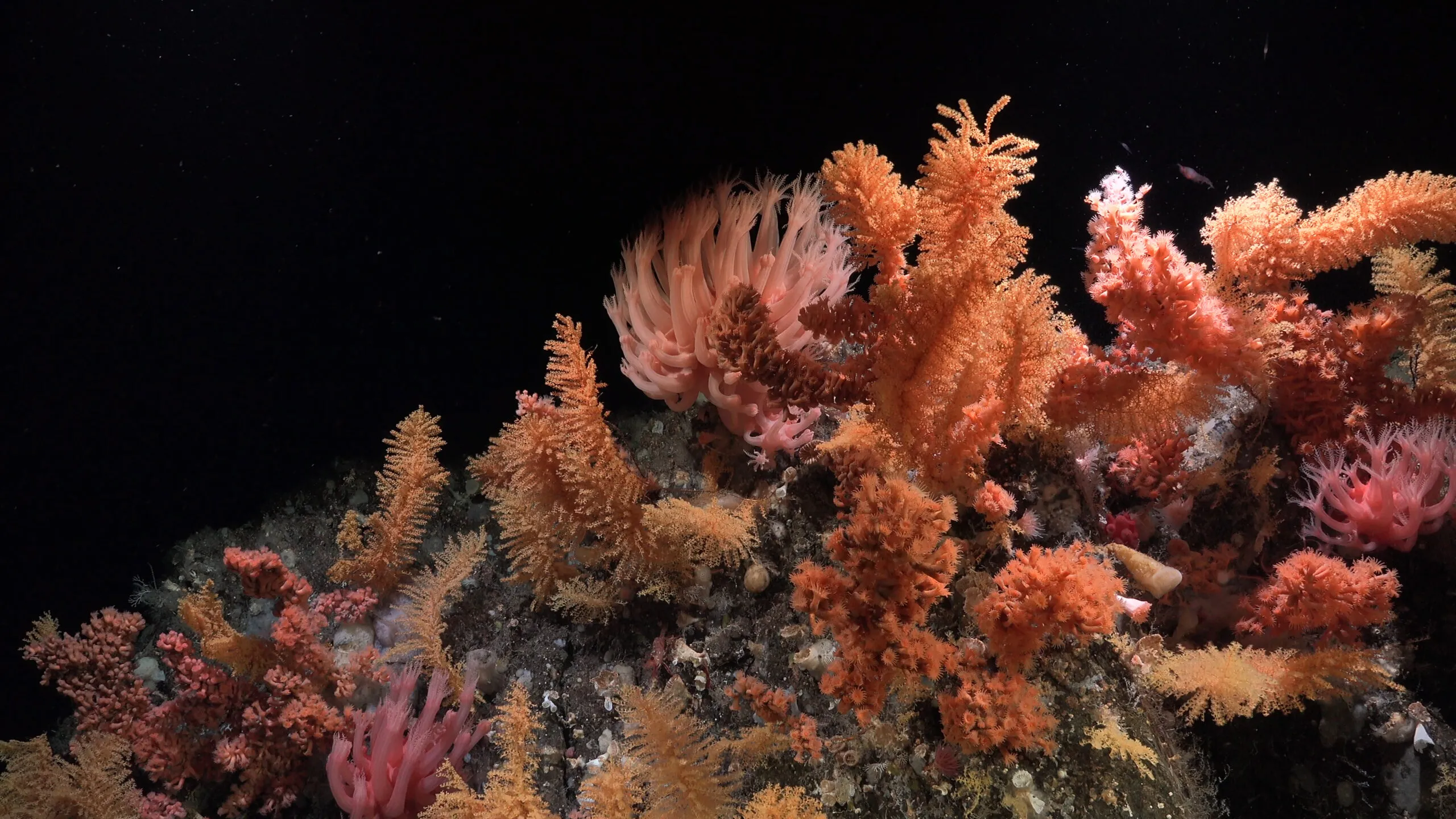
Photo credit: ROV SuBastian/Schmidt Ocean Institute, CC BY-NC-SA
The following letter was sent to Prime Minister Mark Carney, Minister of Fisheries, Oceans and the Canadian Coast Guard Joanne Thompson, Minister of Natural Resources Tim Hodgson, Minister of Foreign Affairs Anita Anand, Minister of Environment and Climate Change Julie Dabrusin, Minister of Canadian Culture and Identity Marc Miller, and Secretary of State (Nature) Natalie Provost by a group of concerned environmental organizations including MiningWatch Canada, Oceans North and Greenpeace Canada.
Dear Prime Minister Carney,
In your speech at Davos, you spoke of the need for middle powers to find new ways of creating alliances. You also reflected on the risks of “going along to get along.” Your words are applicable to many challenges facing us today. Treaties and institutions that grant security, stability, and establish known mechanisms for peaceful settlement of disputes and collective decision making are under fire. One such institution is the International Seabed Authority (ISA) under the United Nations Convention on the Law of the Sea (UNCLOS) — both of which are under threat due to efforts to mine the international seabed while bypassing UNCLOS jurisdiction.
A subsidiary (TMC-USA) of a Canadian mining company, The Metals Company submitted an application to mine the international seabed though the US Deep Seabed Hard Mineral Resources Act (DSHMRA). Parties to UNCLOS are legally obligated to ensure their nationals and corporations do not claim or exercise rights to the international seabed outside UNCLOS. Canada is obligated to take action to ensure its nationals and juridicals abide by the rules and responsibilities laid out in UNCLOS and this applies to the actions of The Metals Company.
As a Party to UNCLOS, your government has a shared responsibility to uphold the legal framework that governs the international seabed area — a part of our planet explicitly recognized as the common heritage of humankind. We are writing to urge your government to take decisive action to address the growing threat posed by unilateral deep-sea mining in the international seabed area. Any plans to proceed with mining activities outside the multilateral framework established under UNCLOS directly undermines the authority of the International Seabed Authority (ISA), which has the mandate to ensure that activities in the Area are carried out for the benefit of humankind as a whole, while ensuring the effective protection of the marine environment.
Any seabed mining activity in the international seabed area that is not authorized by the ISA must therefore be treated as illegal.
We respectfully request your government to:
- Ensure that all Canadian enterprises, citizens, and companies do not engage in activities in the Area except in full compliance with UNCLOS (Article 139).
- Ensure that no natural or juridical person claims, acquires, or exercises rights over minerals recovered from the Area except in accordance with UNCLOS (Article 137).
- Strengthen collective oversight and accountability through the ISA, including robust control over all contractors and clear consequences for non-compliance.
- Adopt a precautionary pause or moratorium on deep-sea mining exploitation at the ISA as a legally binding precautionary measure prohibiting mining in the Area, consistent with Article 145 of UNCLOS, and deterring unilateral actions.
Ensuring deep-sea mining does not wreak havoc in the ocean is particularly important in light of the recent entry into force of the new Agreement for the conservation and sustainable use of marine biodiversity beyond national jurisdiction (BBNJ Treaty).
The international community is increasingly clear on this issue. A growing number of countries, alongside 70+ major businesses and financial institutions, nearly 1,000 marine scientists, the UN Special Rapporteur on Human Rights, the fishing sector, Indigenous communities and civil society have concluded that deep-sea mining is reckless, unnecessary, economically unviable, incompatible with a sustainable future, and that a moratorium or precautionary pause is required.
We urge your government to publicly denounce efforts by a Canadian company to engage in unilateral deep-sea mining, defend the ocean environment through an international legally binding moratorium or precautionary pause on exploitation, and uphold the authority of the ISA, multilateral cooperation, and the integrity of UNCLOS.
Yours Sincerely,
Susanna Fuller, Oceans North
Catherine Coumans, MiningWatch Canada
Sien Van den broeke, Greenpeace Canada
Karen Hamilton, Above Ground
Nicole Desgagnes, arrêt des rejets et émissions toxiques de Rouyn-Noranda
Michel Picard, Association pour la protection du lac Taureau
David Roy, Ateliers pour la biodiversité
Richard van der Jagt, Canadian Association of the Club of Rome
Frances Deverell, Canadian Unitarians for Social Justice
Léa Delambre, Centr'ERE
Geneviève Brisson, Centre de recherche en développement territorial
Dan Lewis, Clayoquot Action
Michael Barkley, Climate Action for Lifelong Learners
Caroline Brouillette, Climate Action Network Canada
Rodrigue Turgeon, Comité citoyen de protection de l'esker
Annabelle-Lydia Bricault-Boucher, Comité pour les droits humains en Amérique latine
Dru Jay, Council of Canadians
Erin Roger, David Suzuki Foundation
Gabrielle Roy-Grégoire, Eau Secours
Vanessa Fiore, Filter Forward
André Bélanger, Fondation Rivières
Beatrice Olivastri, Friends of the Earth Canada
Suzanne Dufresne, Grandmothers Advocacy Network
Karen Wristen, Living Oceans Society
Isabelle Fortin-Rondeau, Mères au front
Cory Greenlees, Mining Justice Action Committee-Victoria
Akaash Maharaj, Nature Canada
Nikki Skuce, Northern Confluence Initiative
Noémi Bureau-Civil, Polémos-décroissance
Martin Vaillancourt, Regroupement national des conseil régionaux de l'environnement duQuébec
Marc Nantel, Regroupement Vigilance Mines de l'Abitibi et du Témiscamingue
Chantal Germain, Revimat
Glenn Wright, Saskatchewan Coalition for Sustainable Development
Cory Greenlees, Victoria Peace Coalition
Karin Mérinat, Village Monde
Michael Bissonnette, West Coast Environmental Law