Deep Seabed Mining: Is Everything New Old Again?
Deep seabed mining’s unprecedented ecosystem risks are exacerbated by environmental and governance practices imported from terrestrial mining
Report published by the Deep Sea Mining Campaign.
Deep sea mining (DSM) risks releasing unregulated radioactivity directly into global ocean commons and marine food chains. There are at least 10 critical knowledge gaps that must be answered before DSM is permitted. We call on the science community and regulatory authorities to undertake a focused investigative effort.
This year has been a year of contradictions. In the midst of US tariffs and tension with Canada’s largest trading partner, the federal government and the governments of B.C., Ontario, Québec, and Nova Scotia all passed or tabled legislation aiming to deregulate the mining sector and incentivize more mining projects. Both in Canada and globally, we saw a worrying trend of dismantling environmental protections, limiting democratic participation, and trampling on Indigenous rights to consent in order to fast-track mining projects in the name of national security and economic growth.
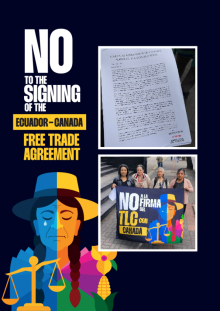
Canada and Ecuador have negotiated a free trade agreement that is fiercely opposed by Indigenous Peoples, trade justice advocates, water defenders and human rights and environmental justice organizations in Ecuador. We join them in opposing the deal for the following reasons.
The provisions of the Projet de Règlement modifiant le Règlement sur les mines (Draft Regulation amending the Mining Regulation, hereinafter "draft regulation") follow the adoption in November 2024 of the Act to amend the Mining Act and other provisions.
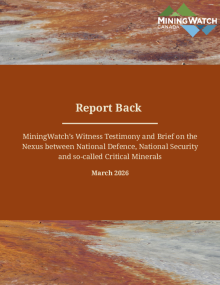
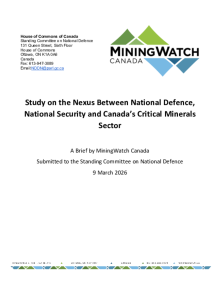
At the invitation of the House of Commons National Defence Standing Committee, MiningWatch Canada submitted a brief to contribute to the Committee’s Study on the Nexus Between National Defence, National Security, and the Critical Minerals Sector in Canada.
This report back includes:
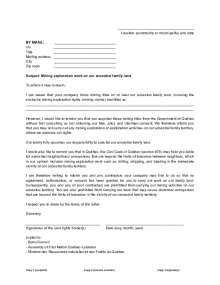
Template letter refusing mining operations on ancestral family territory.
The Metals Company (TMC), a publicly-traded company on the NASDAQ, has released a Pre-Feasibility Study prepared by AMC Consultants Pty Ltd (2025) for the mining of deep-sea nodules in the Clarion Clipperton Zone in the northeast Pacific Ocean. TMC is seeking an exploitation permit from the US National Oceanic and Atmospheric Administration (NOAA), rather than from the International Seabed Authority (ISA), which has not yet developed the regulatory framework for issuing exploitation permits.
This report is based on fieldwork carried out by Catherine Coumans, Asia Pacific Program Coordinator at MiningWatch Canada, on Sangihe Island in November 2025. It details the issues related to mining on small islands in Asia Pacific and the ongoing struggle by the grassroots Save Sangihe Island (SSI) coalition to protect Sangihe Island from gold mining by Canadian company Baru Gold Corp. The report discusses:
The purpose of this brief is to present an analysis of the proposed Bill to accelerate authorizations required for the completion of priority and national-scale projects (PL5). The brief was produced by Eau Secours, with the support of the Coalition Québec meilleure mine (QMM) and Sept-Îles Sans Uranium (SISUR), and aims to convey our comments and positions regarding the proposed legislation.
The brief is available in french only.