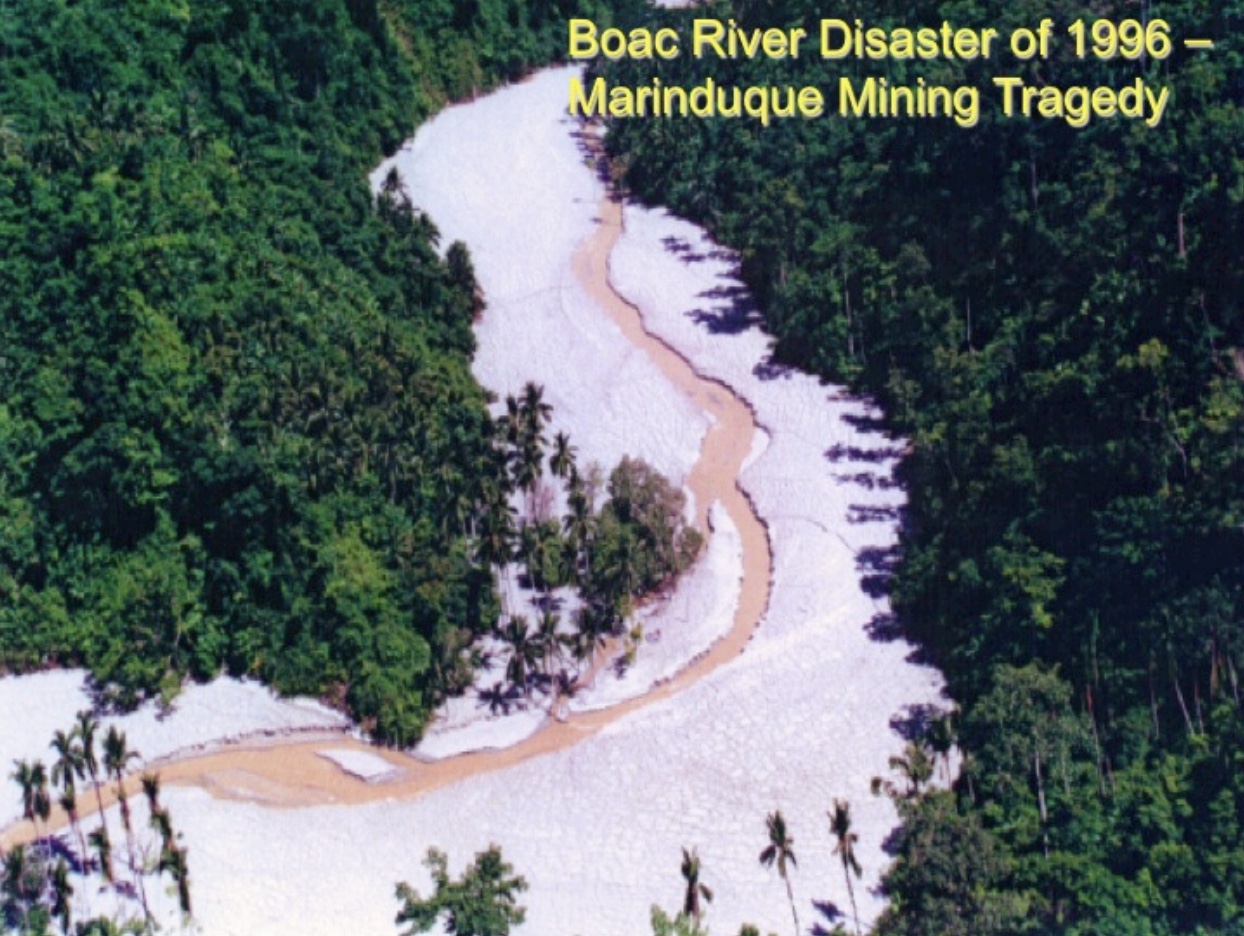
Thirty years ago today, on the Philippine Island of Marinduque, people woke up to the largest mining disaster in Philippine history unfolding outside their homes. A major river on the island was filling up with mine waste from the mountains to the sea after a mine waste containment structure at the Marcopper Mine failed.
Five villages and some 4,400 villagers were immediately cut off by the mine waste and had to be serviced and evacuated by helicopter. In the village of Hinapula the waste was as high as 6 feet and 400 families had to flee to higher ground. Twenty villages along the Boac River were immediately affected. Rice fields and other food crops were destroyed. The river – which had been a means of transportation, a source of water for irrigation and for watering animals, as well as a rich source of food and livelihood for thousands of villagers – was rendered useless.
The mine was part-owned and managed by Canadian mining company Placer Dome Inc.
The Boac River catastrophe was not the first major failure of the Marcopper mine. Three years earlier, in the night of December 6, 1993, a siltation dam at the mountainous mine site burst with disastrous effect. Waste contained behind the dam flooded down the Mogpog River washing away homes in the mountains, flooding rice fields, killing livestock, and filling homes in the low-land town of Mogpog with waste and silt several feet high. Two young children were buried in the mine waste and died. They were Christina Tagle, age 3, and Josephine Tagle, age 6.
Before that, the mine had disposed of its mine waste by dumping it into the ocean at the wide and shallow bay. This dumping went on day and night from 1975-1991. Over time, some 200 million tons of tailings covered two major coral reefs and seagrasses over 80 square kilometres of the bottom of Calancan Bay. The tailings formed a causeway that eventually reached some 5 miles out into the sea. Fishers from 12 villages were severely affected as their rich fishing ground was slowly buried and they experienced the effects of metal leaching from the mine waste.
The Boac River spill finally closed down the mine, which had started operations in 1969. Marinduqueños have fought for justice, and for rehabilitation of their severely degraded ecosystems, ever since.
This week, MiningWatch will share updates on the legal struggle of the people of Marinduque and reflections on the long history of struggle to recover from decades of irresponsible mining.
For a brief summary of the mining disasters in Marinduque, see this report.