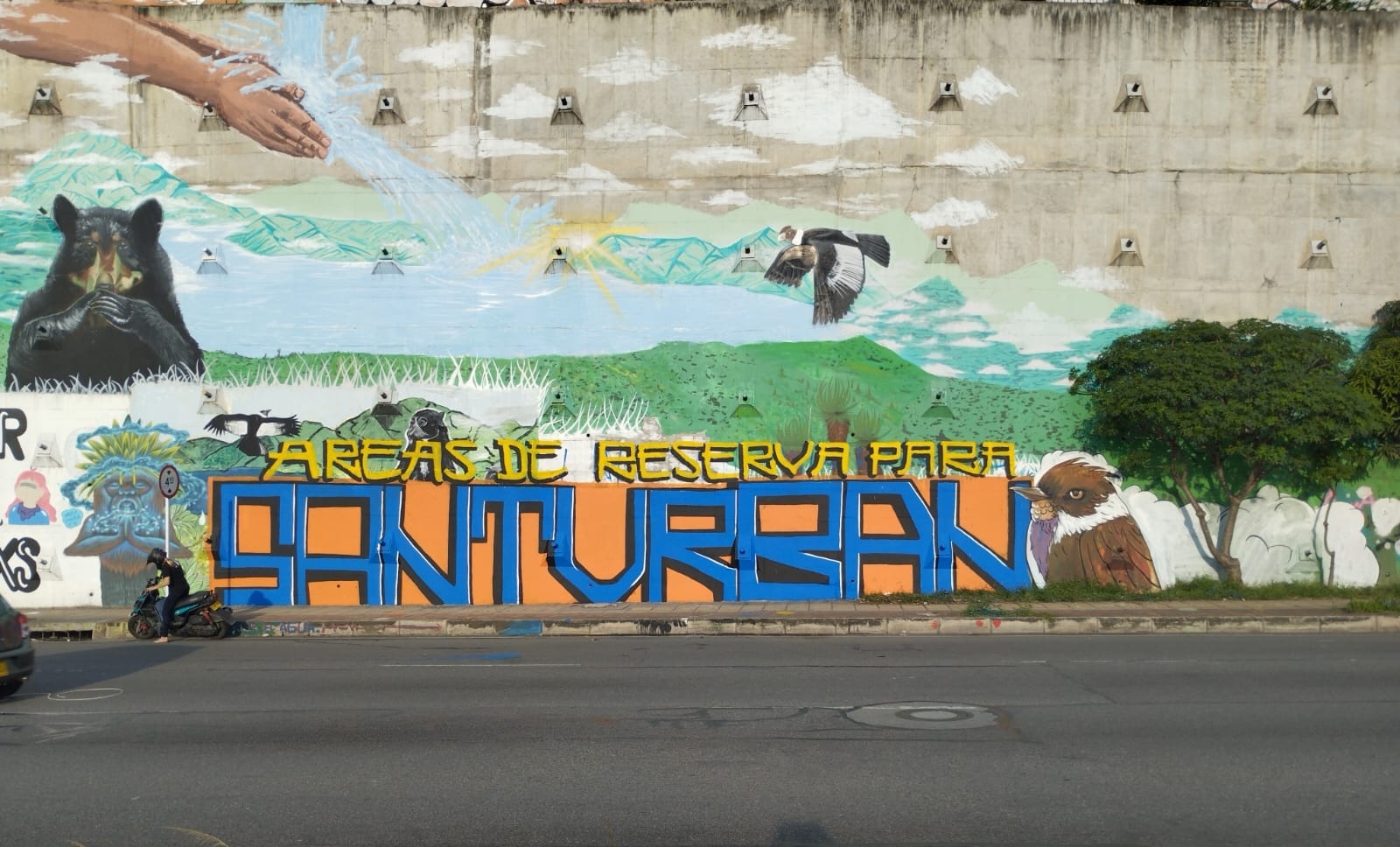
On International Human Rights Defenders Day, Colombian environmental defenders and international allies are questioning Canadian authorities’ ongoing silence as these defenders continue to face serious threats to their safety related to their activism against an Aris Mining Corporation project in Colombia. The Committee for the Defense of Water and the Santurbán Páramo in Santander, Colombia, has been stigmatized and criminalized for working to protect the Santurbán páramo, a high-altitude wetland ecosystem on which more than two million people depend for their fresh water supply.
Over the past year, the Committee has been instrumental in achieving significant victories for the protection of the Páramo. It organized a large march, in which 20,000 people took to the streets in defence of water and the Santurbán páramo – one of the many mass demonstrations they have organized over the past 16 years in the city of Bucaramanga. The mobilization helped achieve an important victory – the recognition of part of the Santurbán páramo as a Temporary Reserve Zone, which led to a two-year suspension of large-scale mining activities in the area. These victories, however, have also resulted in an increase in attacks against the Committee.
In December 2024, members of the Committee were designated as “persona non grata” in a pamphlet circulated on social media and by local authorities. The authors of the pamphlet call themselves the “Soto Norte Resistance Committee.” According to the complaint, the pamphlet was distributed by individuals with alleged interests or ties to the Soto Norte project for the exploitation of gold and other minerals. The project has been managed by Sociedad Minera de Santander S.A.S. (today Sociedad Proyecto Soto Norte S.A.S.), which in turn holds a subcontract with CALIMINEROS S.A.S. It should be noted that the majority investor in the Soto Norte S.A.S. project is the Canadian company Aris Mining, which also recently announced the acquisition of the entire project.
The Committee's important work warning of the serious risks of these activities for the Páramo and the region's water has led to persistent threats and reprisals against its members, including those in the pamphlet. As a result of these attacks, members of the Committee have reported that they cannot move freely and safely throughout the region, which limits their environmental activism and violates various constitutional guarantees, including their right to personal integrity, freedom of expression, and freedom of movement.
Following the increase in threats to its members, the Committee, along with international allies, sent a letter to the Canadian Embassy in Colombia, Global Affairs Canada, and various agencies of the Colombian government to report the accusations against them and request that they take the necessary measures to protect its members. Prior to this, the Committee filed a criminal complaint with the Colombian Attorney General's Office and disciplinary complaints against Colombian government officials who had also allegedly participated in acts of stigmatization and harassment.
In March 2025, various UN experts, including Special Rapporteurs and the Working Group on Business and Human Rights, raised concerns. In a joint action, the UN experts sent letters to the governments of Colombia, Canada, and the United Arab Emirates, as well as to Aris Mining and MDC Industry Holding Company LLC, requesting information about the progress of the complaints and the measures being taken to protect Committee members. At the time of this publication, only the Colombian government, Aris Mining and MDC Industry Holding Company LLC have responded to the UN experts. The latter was consistent with Aris Mining's response, which denies the allegations of intimidation against Committee members.
Seven months have passed since the UN experts requested information, and almost a year since the letter was sent to the Canadian embassy in Colombia. However, the safety of the Santurbán Committee defenders remains at risk, the investigations by the Colombian justice system have not yielded any concrete results, and Canada, where the company is headquartered, remains silent.
Response from Aris Mining
The letter from the UN special rapporteurs to Aris Mining describes the threats received by members of the Santurbán Committee as “serious concerns.”
One of the allegations in the UN letter is that “[t]hose who shared the pamphlet reportedly included, among others, the legal representative of the mining company CALIMINEROS, which has a formalisation subcontract with Sociedad Minera de Santander S.A.A (MINESA), co-owned by your company, Aris Mining, and MDC Industry Holding Company LLC.” The letter also emphasizes that Aris Mining, its subsidiary MINESA, and all companies in its supply chain—such as Calimineros—associated with the Soto Norte project have an obligation to respect and protect human rights, especially the rights of environment and water defenders.
Thus, the letter addressed by the UN experts to Aris Mining states: “Without wishing to prejudge the accuracy of the information received, we wish to express our serious concern at the alleged intimidation of Ms. López Carreño and Mr. Morantes [members of the Santurbán Committee], which we fear to be directly linked to their work to protect human rights, including the rights to safe drinking water and to a clean, healthy, sustainable environment, in the context of the development of the Soto Norte mining project”
Aris Mining responded two months after the deadline, on May 28, citing problems with the emails to which the UN rapporteurs had sent their communications. The company states: “In response to the allegations outlined in your letter regarding the intimidation of Ms. López Carreño and Mr. Morantes both in the digital pamphlet and otherwise, we remain steadfast in our assertion that we do not and have not participated in, nor do we condone, the intimidation of anyone, including Ms. López Carreño and Mr. Morantes.” It further states that “we were not involved in any way with the preparation or dissemination of the alleged digital pamphlet and do not in any way condone the same.”
The company also emphasizes that “Ms. López Carreño and Mr. Morantes' efforts to protect human rights, including the rights to safe drinking water and to a clean, healthy, sustainable environment, are fully consistent with our vision for all of Aris Mining's operations, including the future Soto Norte Project.”
Notwithstanding the above, and instead of responding to the questions raised in the UN experts' letter regarding the measures implemented by the company, its subsidiaries, or subcontractors to prevent the violation of environmental defenders' rights, Aris Mining evades the questions and states: “we believe a partnership with CALIMINEROS… would pave the way to protecting the region's water resources.”
Although Colombia remains one of the most dangerous countries in which to defend land and nature, as highlighted by Global Witness in its 2024 Roots of Resistance report, Aris Mining CEO Neil Woodwyer, addressing his investors, stated that “There is a difference between actual risk and perceived risk… There’s a movie history associated with Colombia, which doesn't do us a lot of good. But in reality, there’s still some areas, but the majority of the country is not like that at all… The country is very stable despite everything.”
This statement ignores the fact that, in the areas of the country where Aris Mining operates, in the departments of Antioquia, Caldas, and Santander, there are illegal groups that pose a constant risk to human rights defenders. This risk is exacerbated by episodes of stigmatization such as that associated with the pamphlet. The serious threats to the members of the Committee in the context of the Aris Mining project in Santander call into question whether the company's investments are being carried out in a safe environment that respects human rights.
Silence from Canada
As Aris Mining is a Canadian company, the UN special rapporteurs also sent a letter to the Canadian government. In it, they remind Canada of its international obligations and ask it to account for the mechanisms it has put in place to protect environmental defenders, including Voices at Risk: Canada’s Guidelines on Supporting Human Rights Defenders.
The Canadian government has stated that “Promoting respect for human rights is at the heart of Canada’s international engagement.” It has also emphasized that: “The Government of Canada recognizes the key role played by human rights defenders in protecting human rights and strengthening the rule of law, often at great risk to themselves and their families and communities.”
Despite Canada's rhetoric and having had almost a year to respond to communications from the Santurbán Committee and UN rapporteurs, it has yet to do so.
While the embassy remains silent about “the steps taken by [the Canadian government] to engage with Aris Mining Corporation regarding its responsibility to respect human rights throughout their operations, including the rights of human rights defenders in the department of Santander”, Global Affairs Canada and Canada's ambassador to Colombia, Elizabeth Williams, have met with the company at least twice this year. In August 2025, the company wrote on its X account: “Aris Mining was honoured to join Canada’s Secretary of State, the Honourable Randeep Sarai and Ambassador Elizabeth Williams at the Embassy of Canada in Colombia in a meaningful and productive dialogue on strengthening cooperation between Canada and Colombia.”
In another post this year with Ambassador Williams, the company says: “Aris Mining values the continued partnership between Canada and Colombia and appreciates the Embassy’s role in fostering collaboration and opportunity across sectors.”
Canada’s lack of response to the allegations against Aris Mining makes it clear that its primary focus is on protecting the interests of Canadian mining companies—even when these concerns come from UN rapporteurs.
Almost a year after these letters were sent, the threats and accusations against the Committee persist, and the authorities have not taken the necessary actions to provide protection to the Committee.
Therefore, Common Frontiers Canada, Institute for Policy Studies - Global Economy Program, Mining Watch Canada, the Center for International Environmental Law (CIEL) and the Committee for the Defense of Water and the Santurbán Páramo reiterate the UN experts' call on the governments of Canada, Colombia and UAE to: (i) safeguard the life and integrity of the Committee members, implement effective protection measures, and investigate those responsible so that these acts do not go unpunished and are not repeated.
Likewise, in accordance with the experts, we insist on their call to MDC Industry Holding Company LLC, Aris Mining, their subsidiaries, and subcontractors to: (ii) respect their international human rights obligations and be accountable for the measures they have implemented to prevent, identify, and remedy any negative impact on human rights resulting from their activities, particularly on the rights of environmental defenders.