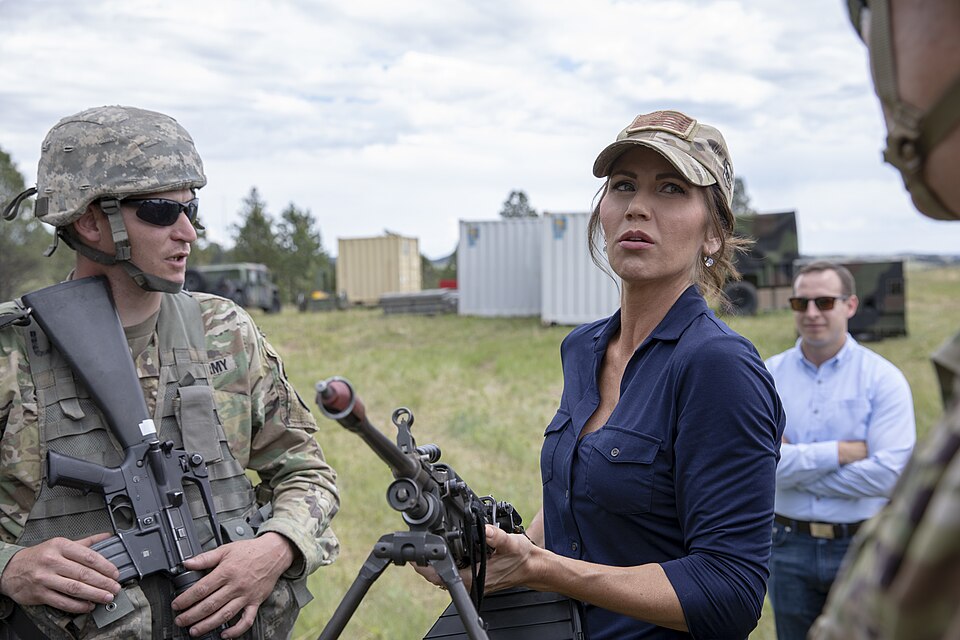
A couple of weeks ago, a little-known Canadian junior mining company appointed former U.S. Secretary of Homeland Security (DHS) Kristi Noem to its advisory board. The backlash from Canadians was swift. The company, NovaRed, was flooded with messages telling its President and CEO Brian Goss that infamous Trump loyalist Noem has no place in a Canadian company. They referred to her history of being banned from multiple tribal lands in the United States, overseeing an immigration crackdown marked by widespread allegations of human rights abuses, dismissing or deflecting accountability when confronted with institutional failures and loss of life under her watch — and referring to Canada as a "51st state." MiningWatch was copied on some of those messages.
So what’s the big deal? Mining companies do bring famous people on board sometimes, perhaps because they have some special talent or expertise, or perhaps more as a stunt to attract attention (and investors). In this case, Noem’s public record indicates that she’s well-suited to helping the company raise the ire of host communities, Indigenous Peoples, and even government regulators trying to follow legal and Constitutional requirements. As for investors, it seems that there is, indeed, such a thing as bad publicity. The company’s stock price bumped up from $1.67 to $1.69 over a couple of days, then as the appointment went viral, slumped, and as of this writing, is down to seventy-five cents.
Even the Globe and Mail noticed, giving Noem’s appointment column-inches that junior mining companies don’t get unless they have a surprise major gold find in Indonesia. Musician and former NDP Member of Parliament Charlie Angus told NovaRed they’ve made a bad mistake that they need to correct – and told his Youtube followers to help “kick [Noem’s] rear-end out of Canada” as he shredded her “qualifications.” And the criticism didn’t just come from “elbows up” Canadians who don’t want to become a 51st state or human rights advocates, but also from industry voices like veteran Canadian Mining Journal writer Marilyn Scales:
You want her government expertise? Your projects are in Canada, and it is impossible to think that with her track record of abusing human rights, ignoring the rule of law, and wild overspending on advertising that you believe you want to run your company that way. Stakeholder engagement? I hope the Indigenous community bans her from their lands as they did in South Dakota and your company, too.
However, as South African journalist Richard Poplak pointed out, this response misses the point, focusing on Noem as an individual while “Canada has always provided a home to vastly useless junior mining ‘companies’ that are just stock market shadow plays.”
The mining industry refers to small exploration companies as “juniors”; they typically have limited cash and share capital, trading on alternative stock markets like the Toronto Venture Exchange (TSX-V) or the Canadian Securities Exchange (CSE). Their shares trade for pennies, or maybe a few dollars, and are considered highly speculative. If they do manage to undertake an exploration project and beat the odds of finding a significant mineral deposit (between 1,000 to one and 10,000 to one, depending whom you ask), their shares can increase in price many times over as they try to flip the property to a company with the capital and expertise to develop it.
As the Globe and Mail’s Niall McGee explained,
NovaRed is a copper and gold exploration company that generates no revenue. It has a market value of approximately $54-million and trades on the speculative Canadian Securities Exchange. As of January, NovaRed was holding only $65,689 in cash, which the company said wouldn’t be enough to cover all of its expected expenses for the next 12 months.
In reality, Noem – and NovaRed – are the symptom, not the disease. This is just a more extreme version of mining companies’ stunt casting, and not even NovaRed’s first. Noem is only part of a recent spate of U.S. Trump regime and military appointments by the company. NovaRed appointed retired U.S. Navy Commander Phil Ehr on March 26, retired U.S. Army Colonel Mark Calabrese on June 10, Noem on June 16, and Truth Social “Senior Communications Advisor” Katie Zacharia on June 24. While the political connections may be obvious, it’s equally obvious that none of these people have any mining experience – or, indeed, relevant experience of any kind.
Maybe NovaRed is bulking up on people with US defence, homeland security, and right-wing media credentials in order to persuade investors the company will be able to secure contracts for “critical minerals” (copper, in this case). If so, they are counting on people not being able to discern that junior mining companies sell dreams and aspirations, not actual metals. And while artillery shells and the like do use up a lot of copper, it’s not in short supply and not considered “strategic” by the Pentagon.
Canada is home to literally thousands of mining companies. But we have remarkably little control over what they do, or even who runs them. How did we get into this situation? Canada, and its provinces and territories, not only facilitate but shovel taxpayer money into a poorly-regulated and highly speculative junior mining sector famous for playing fast and loose with investors’ money. In recent years, even Canadian residency requirements have evaporated; only Manitoba still requires any corporate directors be Canadian (25%), and of course “advisory boards” have no legal standing whatsoever.
Some rules around this business would help. We could start with meaningful financial disclosure – and residency requirements for directors, limits on interlocking Board memberships, and restrictions on self-dealing so mining execs can’t contract their own companies (or their buddies’) to do work for themselves without an open competition. We could ban subsidiaries in tax havens and secrecy jurisdictions, too. We could even cut off flow-through share financing and with it, the charitable tax dodge that allows wealthy investors to cut their tax exposure with no accountability.
Maybe best we don't hold our breath, though. These folks have influential friends, after all. But we will keep pushing. In the meantime, let’s keep working to reign in their excesses on the ground, reforming provincial and territorial mining laws, securing Free, Prior, and Informed Consent for Indigenous Peoples, and supporting community and Indigenous Peoples’ rights.
Photo: U.S. Army Reserve photo by Spc. Jamaal Turner, Public domain, via Wikimedia Commons
.jpg)