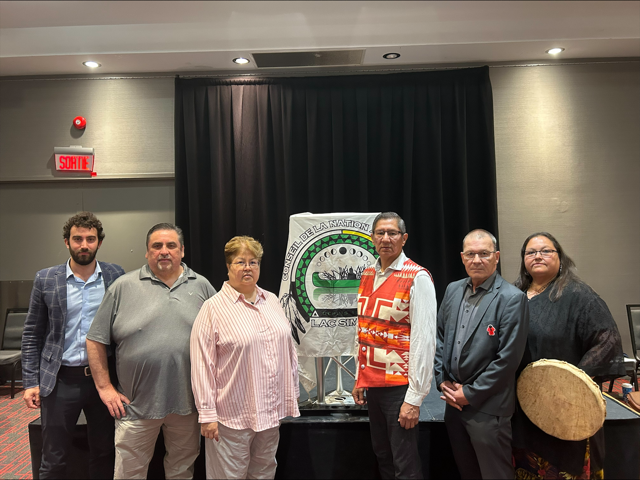
Val d’Or — The Anishnabe Nation of Lac Simon announces the mobilization of a united front of Anishinabe Chiefs aimed at calling for increased participation of First Nations in the process of allocating mining claims on their ancestral territories.
Bringing together representatives of First Nations and civil society, this mobilization comes in the wake of recent mining development projects carried out without the free, prior and informed consent (FPIC) of First Nations. This is notably the case with the Novador project by mining company Fresnillo, whose process leading to the issuance of Authorizations for Impact-causing exploration Work (“ATI”) is currently the subject of a legal challenge filed by the Anishnabe Nation of Lac Simon on June 13.
Gathered in Val-d’Or, Chief of the Anishnabe Nation of Lac Simon, Lucien Wabanonik; Vice-Chief of Lac Simon, Danny Pien; Grand Chief of the Algonquin Anishinabeg Nation Tribal Council, Verna Polson; Chief of Kebaowek First Nation, Lance Haymond; Chief of Long Point First Nation, Steeve Mathias; Chief of the Abitibiwinni First Nation, Chantal Kistabish, with the support of Rodrigue Turgeon of MiningWatch Canada, issued a clear call to the Government of Quebec to modernize the mechanisms for allocating mining claims and to ensure respect for the free, prior and informed consent of First Nations.
On this occasion, a letter signed by several Anishinabe elected leaders was sent to the Minister of Natural Resources and Forests, Ms. Kateri Champagne-Jourdain. This initiative aims to remind that First Nations’ ancestral territories are neither vacant nor available without their participation, and that Indigenous governments must hold a decisive place in decision-making processes related to natural resource development.
“Too long have mining claims been granted on our territories without First Nations having a real place in decisions that affect them. This is the approach that must change. The predictability sought by investors, proponents and governments is not achieved by bypassing us, but by working with us, from the very outset, even before mining claims are granted, in full respect of our rights, our governments, and free, prior and informed consent. If Quebec truly wishes to build a Nation-to-Nation relationship, it must begin at the earliest stages of development,” said Lucien Wabanonik, Chief of the Council of the Anishnabe Nation of Lac Simon.
Necessary Changes to Ensure Sustainable and Predictable Development
The Anishnabe Nation of Lac Simon reiterates that it does not oppose economic development. On the contrary, it seeks to actively participate in shared prosperity based on the responsible development of natural resources. However, it deplores that the current regime still allows for the granting of mining rights on its territory without its meaningful participation and prior to decision-making.
Representatives gathered today also emphasized that responsible development is based on dialogue, mutual respect and the recognition of First Nations’ rights—conditions essential to the stability and predictability sought by proponents, investors and governments, particularly in a context of economic uncertainty.
A Clear Message to the Next Government
This initiative, led by the Anishnabe Nation of Lac Simon and supported by several First Nations, also served to highlight that the next government must make respect for First Nations’ rights a fundamental condition of its actions. The Chiefs assembled also reiterated in their letter to the Minister that their ancestral rights are recognized and protected by the Canadian Constitution, and that their governments must be considered essential partners in any decision likely to impact their territories.
The First Nations gathered now expect concrete actions aimed at recognizing their decision-making roles, modernizing the mechanisms for allocating mining claims, and ensuring respect for free, prior and informed consent.
Governance Tools that Cannot be Ignored
In recent years, the Anishnabe Nation of Lac Simon has developed and adopted governance tools as well as mechanisms governing consultation and the authorization of activities likely to impact its territory. Based on the right to self-determination, on rights protected under section 35 of the Constitution Act, 1982, and on FPIC—a principle recognized by the United Nations Declaration on the Rights of Indigenous Peoples (UNDRIP)—these tools establish the essential minimum conditions for responsible development on the Nitakinan. The Anishnabe Nation of Lac Simon expects that its processes, decisions and rights will be fully respected by governments and proponents seeking to operate on its territory.
Quotes :
“The issues we are raising today go well beyond the borders of Quebec. This is also a struggle we are carrying at the national and international levels, where we were actively engaged as recently as last week in Europe. Everywhere, Indigenous Peoples are calling for meaningful participation in decisions affecting their lands and resources. First Nations are governments in their own right, engaged in political, economic and diplomatic relations on a global scale. Our advocacy serves as a reminder that respect for Indigenous rights has become an unavoidable international issue and an essential component of any responsible development,” said Danny Pien, Vice-Chief of the Council of the Anishnabe Nation of Lac Simon.
“Today, Anishinabeg Chiefs stand united to affirm that our ancestral territories, both on the land and beneath the surface, must be at the heart of all decisions that affect them. We move forward together to ensure that any development respects our rights, our responsibilities, and our way of life. United, we are clear that decisions must be made with us, not without us," said Verna Polson, Grand Chief of the Algonquin Anishinabeg Nation Tribal Council.
“We fully support the Anishnabe Nation of Lac Simon in its actions, whether legal—including its court challenge against the Novador project by mining company Fresnillo—or political, with the objective that First Nations have a say in the allocation of mining claims. As Quebecers, it is important to remember that it is precisely this free mining regime—the archaic but deliberate and repeated choice of the government to prioritize mining interests above all else—that is the source of uncertainty in the mining sector, not the respect of Indigenous rights. It is possible to change the system to respect nature and Indigenous rights without preventing all mining activity, but it takes courage to stand up to mining lobbies, and it is clear that this government lacks it,” said Rodrigue Turgeon, lawyer, co-spokesperson of the Québec meilleure mine coalition and co-lead of MiningWatch Canada’s national program.
Official photo, from left to right: Rodrigue Turgeon; Steeve Mathias; Chantal Kistabish; Lucien Wabanonik; Lance Haymond; Verna Polson.
Source : Le Conseil de la Nation Anishnabe de Lac Simon
For information or interview request:
Pascal Deslauriers
Media Relations Advisor
relationsmedias@seize03.ca
514-295-2103