Ecuadorians have repeatedly rejected investor-state arbitration. Canada’s new trade deal would bring it back
Two decisions by Prime Minister Mark Carney’s government, made just weeks apart, lay bare Canada’s approach to corporate accountability.
In June, Carney announced the abrupt closure of the Canadian Ombudsperson for Responsible Enterprise (CORE), a federal office mandated to review allegations of human rights abuses linked to the overseas conduct of Canadian extractive and garment companies and report on its findings. A month later, Canada signed a free trade agreement with Ecuador that grants sweeping protections to Canadian mining investors—at a time when Ecuadorians face a deepening human rights crisis linked, in part, to existing Canadian mining investments.
The message is clear: Canada is strengthening legal protections for Canadian investors abroad while abandoning any pretense of holding those same corporations to account at home for their conduct. It’s Carney’s “principled and pragmatic” approach to global engagement in action.
A trade deal that violates Ecuador’s constitution
The Canada-Ecuador Free Trade Agreement was officially signed on July 24 in Ottawa by Canadian Minister of International Trade Maninder Sidhu and Ecuadorian Minister of Production, International Trade and Investment Luis Alberto Jaramillo.
The agreement was and continues to be widely opposed by Ecuadorian civil society, which was left out of consultations, and by Indigenous and campesino organizations, which were neither informed nor gave their consent to the deal. A cross-section of organizations and leaders in Canada representing Indigenous communities, trade justice, labour, environmental, and corporate accountability advocates have also been vocal in their opposition.
Ecuador has long been a destination for Canadian mining investment. But over the two years of formal trade negotiations, Ecuador adopted a series of regressive laws aimed at attracting and facilitating more mining investment—including the Law for the Strengthening of the Strategic Mining and Energy Sectors, which removes key environmental licensing requirements to fast-track mining projects, and the Law on Social Transparency, which imposes sweeping restrictions on civil society organizations and effectively makes it illegal to protest mining projects authorized by the government.
Canadian projects have already been allowed to advance in ecologically sensitive areas of Ecuador, putting vital water sources for millions of Ecuadorians at risk. In farming communities, the military has been deployed to fast-track and rubber-stamp environmental consultations and violently suppress peaceful protests. Projects have advanced despite suspension orders by local courts for failing to ensure the free, prior, and informed consent of affected Indigenous peoples.
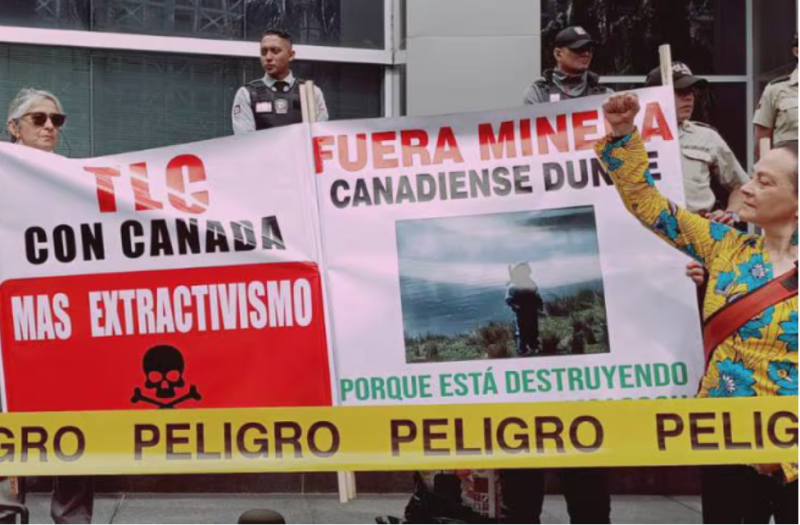
In one example, Canadian company Dundee Precious Metals is attempting to advance its copper-gold Loma Larga mine in the páramo de Kimsakocha in southern Ecuador—a high-altitude wetland that plays a fundamental role in regulating and recharging the region’s water cycle and is key to biodiversity conservation in the Andes. An independent review of the proposed project warned that mining activities would likely lead to widespread arsenic contamination, given the interconnection between the páramo and the groundwater that sustains tens of thousands of the region’s inhabitants.
The project has faced decades of sustained resistance from Indigenous and campesino communities and water defenders. In popular consultations in Victoria del Portete in 2011, Girón in 2019, and Cuenca in 2021, overwhelming majorities voted to protect the páramo and the region’s water sources from mining. That opposition has only grown. In September 2025, more than 100,000 people flooded the streets of Cuenca in one of the largest demonstrations in the city’s recent history, demanding the cancellation of the Loma Larga project. Dubbed Cuenca’s “Fifth River,” the march brought together Indigenous and campesino organizations, water defenders, local authorities, the Catholic Church, health institutions, and communities from across Ecuador in a massive show of opposition to mining in Kimsakocha.
Hortencia Zhagüi is a member of the Kimsakocha Women’s School of Agroecology and the Board of Potable Water Administrators of Victoria del Portete and Tarquí. She traveled to Canada in 2024 to meet with Members of Parliament and the Canadian public while trade negotiations were underway, to demand a deal not be signed. “Kimsakocha is not just a territory—it is a source of life,” she says. “Its waters sustain thousands of Indigenous and campesino families who depend on agriculture, livestock, and access to clean water. This agreement, by facilitating the expansion of extractive activities, puts our ecosystems, our water sources, and our way of life at risk.”
Today, Canada officially signed a Free Trade Agreement with Ecuador alongside Luis Alberto Jaramillo, Ecuador’s Minister of Production, Foreign Trade and Investment, marking an important step forward for Canadian businesses, workers and exporters.
This agreement will open new… pic.twitter.com/ZgHcXBcj8t— Maninder Sidhu (@MSidhuLiberal) July 24, 2026
Lack of transparency and consent are not the only concerns about the agreement. The trade deal includes an Investor-State Dispute Settlement (ISDS) mechanism, which would allow Canadian investors to sue the Ecuadorian government in private arbitration for alleged violations of their treaty rights. Globally, mining companies have repeatedly used these mechanisms to seek hundreds of millions—and sometimes billions—of dollars in compensation when governments deny permits, strengthen environmental protections, or otherwise adopt measures that affect the profitability of their investments. The risks are particularly acute in Latin America, one of the regions most targeted by ISDS claims worldwide. According to a 2026 analysis by the Transnational Institute, Ecuador is already among the five most-sued countries in the region, having faced 30 investor claims.
That experience led Ecuador to explicitly prohibit international investor-state arbitration in its 2008 constitution, a prohibition Ecuadorians have repeatedly defended at the ballot box. Most recently, in a 2024 referendum, nearly two-thirds of voters rejected a proposal that would have reopened the door to international investor-state arbitration, reaffirming a constitutional restriction that successive governments have sought to reverse.
Despite this, Canada and Ecuador have tried to get around the constitutional ban by creating a bespoke set of arbitration rules independent of, but largely mirroring, those of the United Nations Commission on International Trade Law (UNCITRAL), the second most commonly used framework for settling ISDS cases. In every other respect, the ISDS process and substantive investment protections are the same as those in other recent Canadian investment treaties.
“This trade deal may contain some creative language around ISDS, but it’s there,” says Stuart Trew, director of the Trade and Investment Research Project at the Canadian Centre for Policy Alternatives (CCPA). “It is a slap in the face to democracy to put an investor-state dispute process in this free trade deal when the Ecuadorian constitution and the people of Ecuador are clearly opposed. This trade deal will give Canadian mining companies a coercive tool to steamroll over local opposition to their projects and avoid accountability for rights violations.”
Canada’s accountability gap widens
The closure of CORE left complainants with active cases in limbo and prompted widespread condemnation. Although the office had long been criticized for lacking the independence and investigative powers originally promised, advocates had called for it to be strengthened, not eliminated.
“The abrupt closure of the Canadian Ombudsperson for Responsible Enterprise (CORE) follows a familiar pattern: when faced with credible allegations of abuse linked to Canadian companies abroad, the government talks about responsible business instead of taking action to stop the harm,” says Aidan Gilchrist-Blackwood, coordinator at the Canadian Network for Corporate Accountability (CNCA). “The CORE had the potential to be a game changer for corporate accountability. Instead, people harmed by Canadian companies still have nowhere to turn.”
The office had been left without an ombudsperson for over a year before its closure. During this time, it continued to receive complaints but could no longer process them. The manner of its closure proved equally troubling. Carney announced the decision without advance notice to complainants—despite claiming it had been made “months ago”—leaving cases in limbo after years spent documenting evidence and participating in the process.
Following the announcement, complainants were advised that their cases could either be closed or transferred to Canada’s National Contact Point (NCP), an OECD mechanism long criticized as ineffective because it does not conduct independent investigations or determine whether companies have violated international standards. What’s more, unlike some of its European counterparts, Canada’s NCP does not recommend remedies for victims. Instead, it relies primarily on voluntary dialogue between communities and corporations, which is poorly suited to cases involving serious human rights abuses or environmental harm.
The NCP is also housed within the International Trade department at Global Affairs Canada, the same section responsible for promoting and protecting Canadian trade and investment abroad. This creates an inherent conflict of interest by placing corporate accountability within the very department tasked with advancing the commercial interests of Canadian companies.
The fight for corporate accountability continues
What’s clear is that human rights oversight continues to take a back seat to Canada’s economic and foreign policy objectives. Now that the Canada-Ecuador Free Trade Agreement has been signed, it goes next to Parliament for ratification. In Ecuador, it must first be reviewed by the Constitutional Court and then approved by the National Assembly before being ratified by the president. Ecuadorian organizations are already filing legal complaints challenging the constitutionality of the agreement and appealing to the Inter-American Commission on Human Rights (IACHR).
Effective and independent mechanisms in Canada that can hold Canadian corporations to account for human rights violations and environmental harm caused abroad are more urgent than ever. The Canadian government continues to prioritize investor protections, giving investors greater power to challenge governments and protect their investments while leaving communities with few avenues for remedy. Carney’s “pragmatism” does not absolve Canada of its international human rights obligations.
Hortencia Zhagüi, from the páramo de Kimsakocha, says it best: “Defending the páramos means defending water, biodiversity, food production, and the future of our communities. That is why we are raising our voices. We demand that the rights of Indigenous Peoples and local communities to be heard are respected, and that any decisions affecting our territories prioritize the protection of nature, our water sources, and the well-being of our communities above any economic interest.”
This article was originally published in Canadian Dimension.
Featured photo: Protesters gather outside the Canadian embassy in Quito on March 4, 2026. “Free Trade Agreement with Canada—More extractivism,” reads the banner. Photo by Acción Ecológica/@AcEcologic.