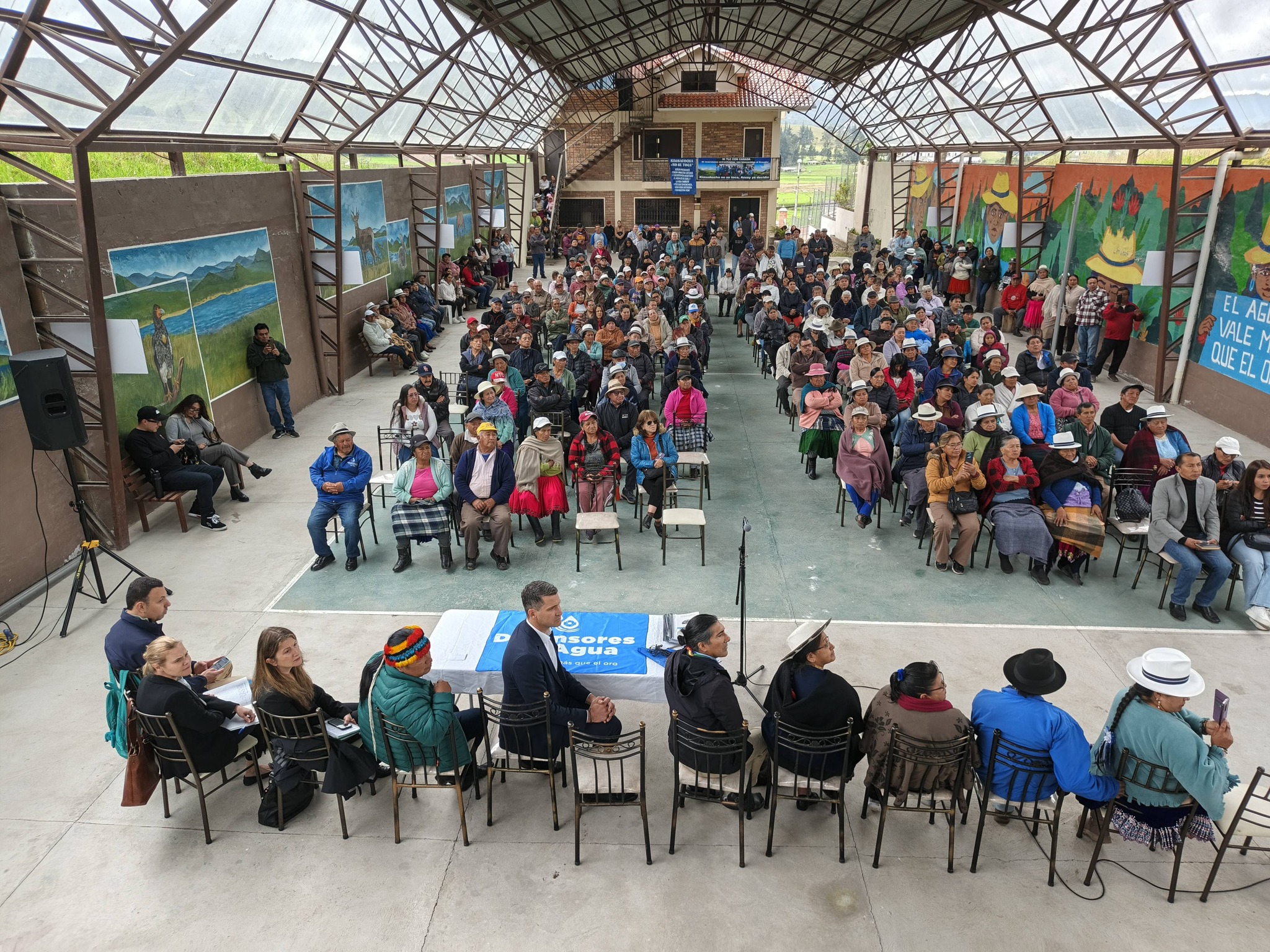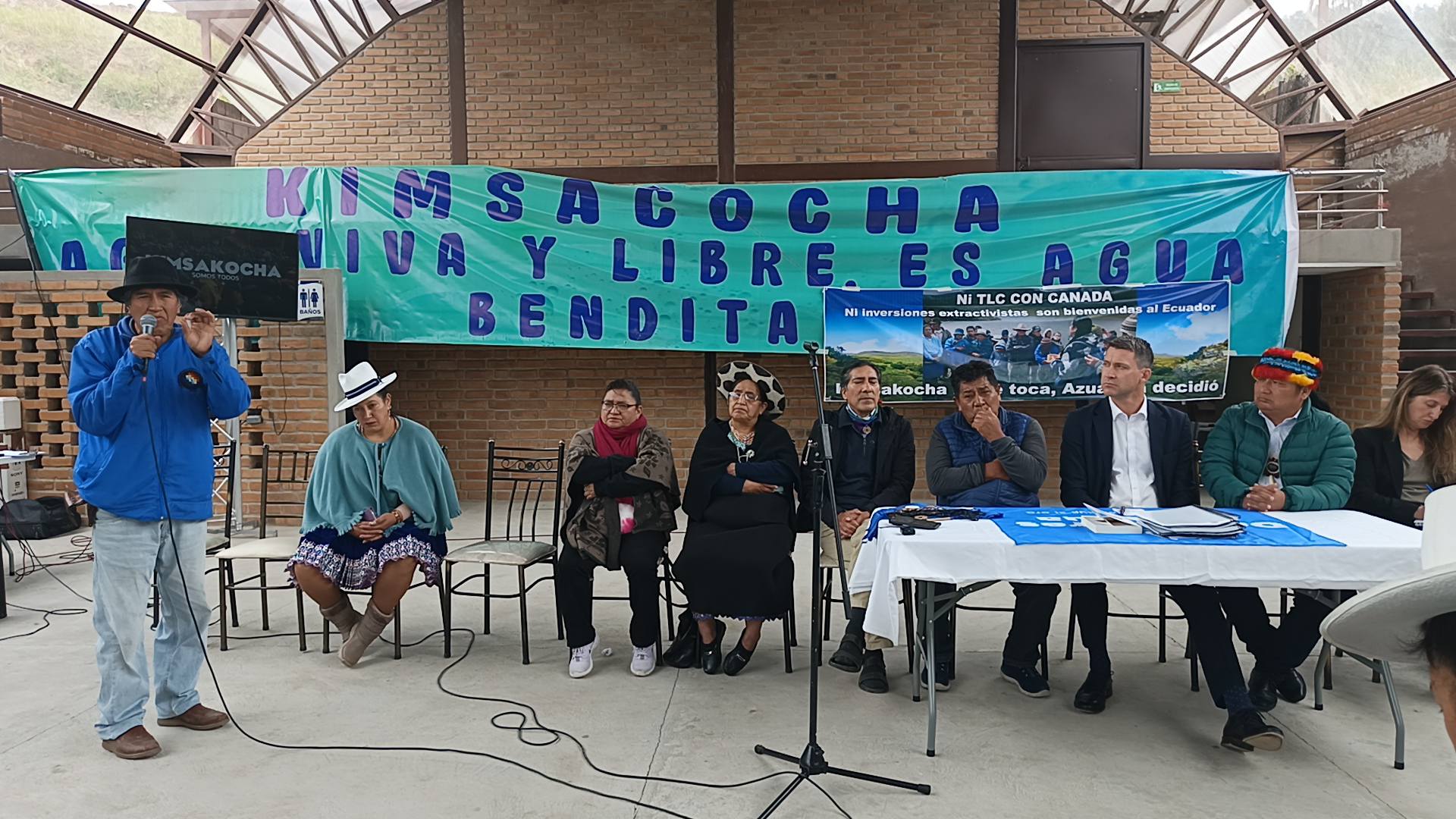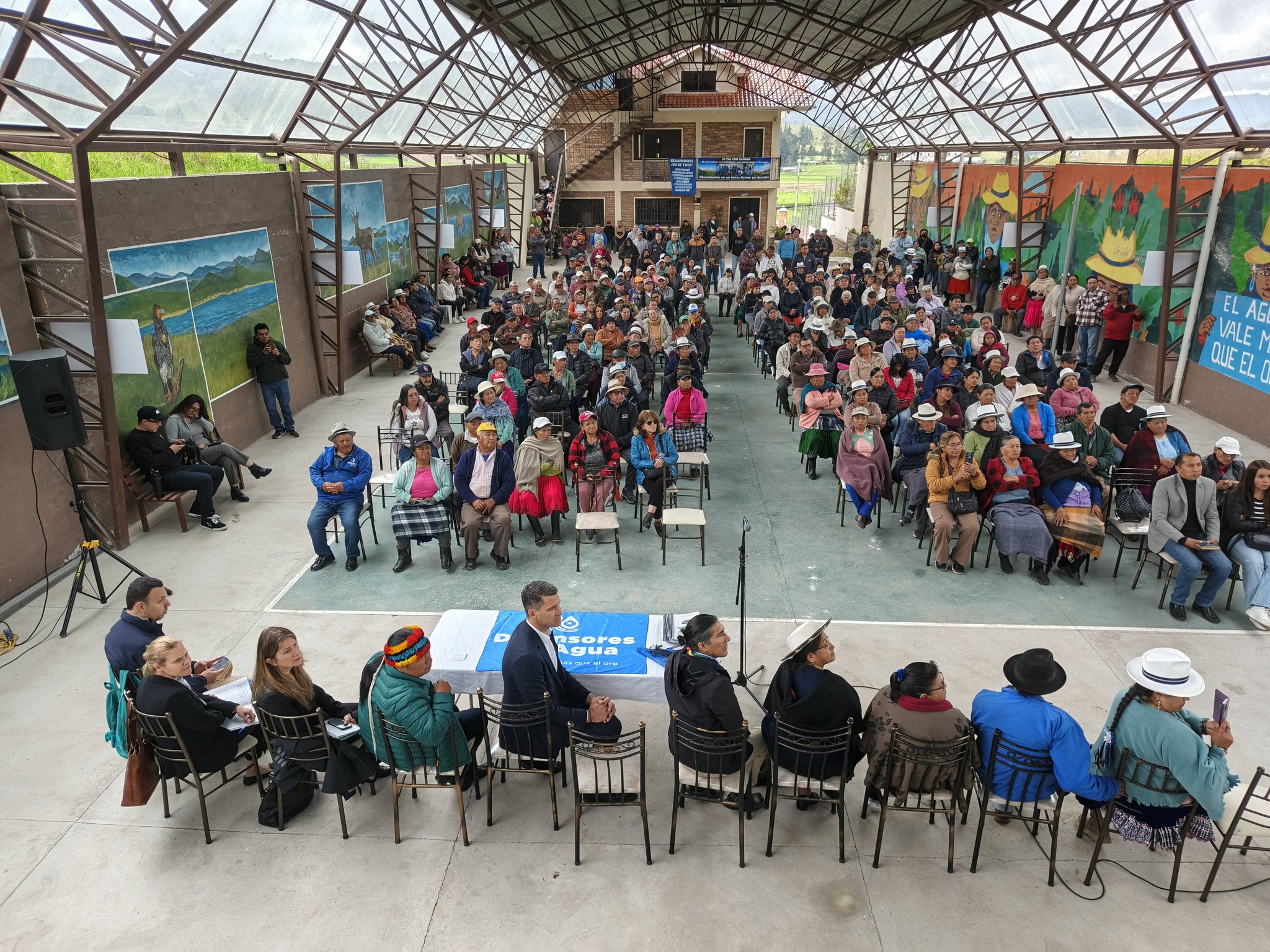
This week, the Canadian ambassador to Ecuador, Craig Kowalik, invited the Federation of Indigenous and Peasant Organizations of Azuay (FOA) and other community representatives from the páramo de Kimsakocha for a meeting to gain firsthand knowledge of their local reality, their priorities, and their relationship with Canada.
For over 30 years, the FOA and other indigenous and rural communities have maintained a strong and peaceful resistance to large-scale mining in the páramo de Kimsakocha, a high-altitude Andean wetland. Multiple Canadian companies have attempted to advance the very contentious Loma Larga gold mining project in the páramo, despite the fact that it would pose a major risk to the groundwater that sustains the lives and livelihoods of tens of thousands of people.
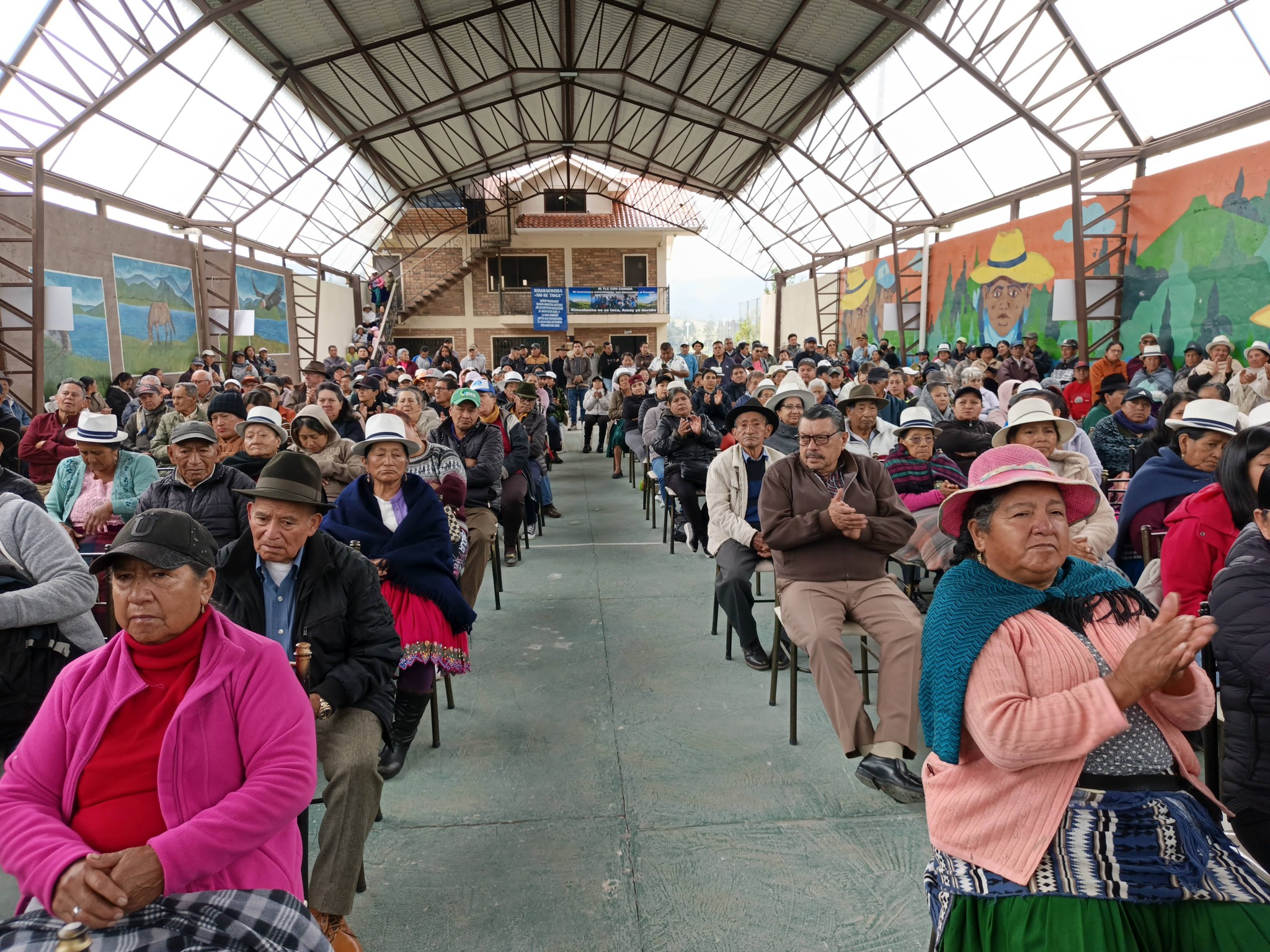
The FOA accepted the Canadian embassy’s invitation and organized a town hall-style assembly on February 3rd. Over 100 local residents, mostly subsistence farmers and ranchers, participated in the gathering to share their social and environmental concerns about Canadian mining in their territory, as well as key concerns about the Free Trade Agreement between Canada and Ecuador.
Seven local and national leaders spoke during the town hall, including Marlon Vargas, president of the CONAIE, the largest Indigenous organization of Ecuador. Other speakers included Lauro Sigcha, Lizardo Zhaqui, and Yaku Perez, members of the FOA, who are among the six water defenders facing criminal charges brought by Canadian DPM Metals for the alleged crimes of damage to property and unlawful association. The charges are related to a mining waste cleanup effort in the Kimsakocha páramo.
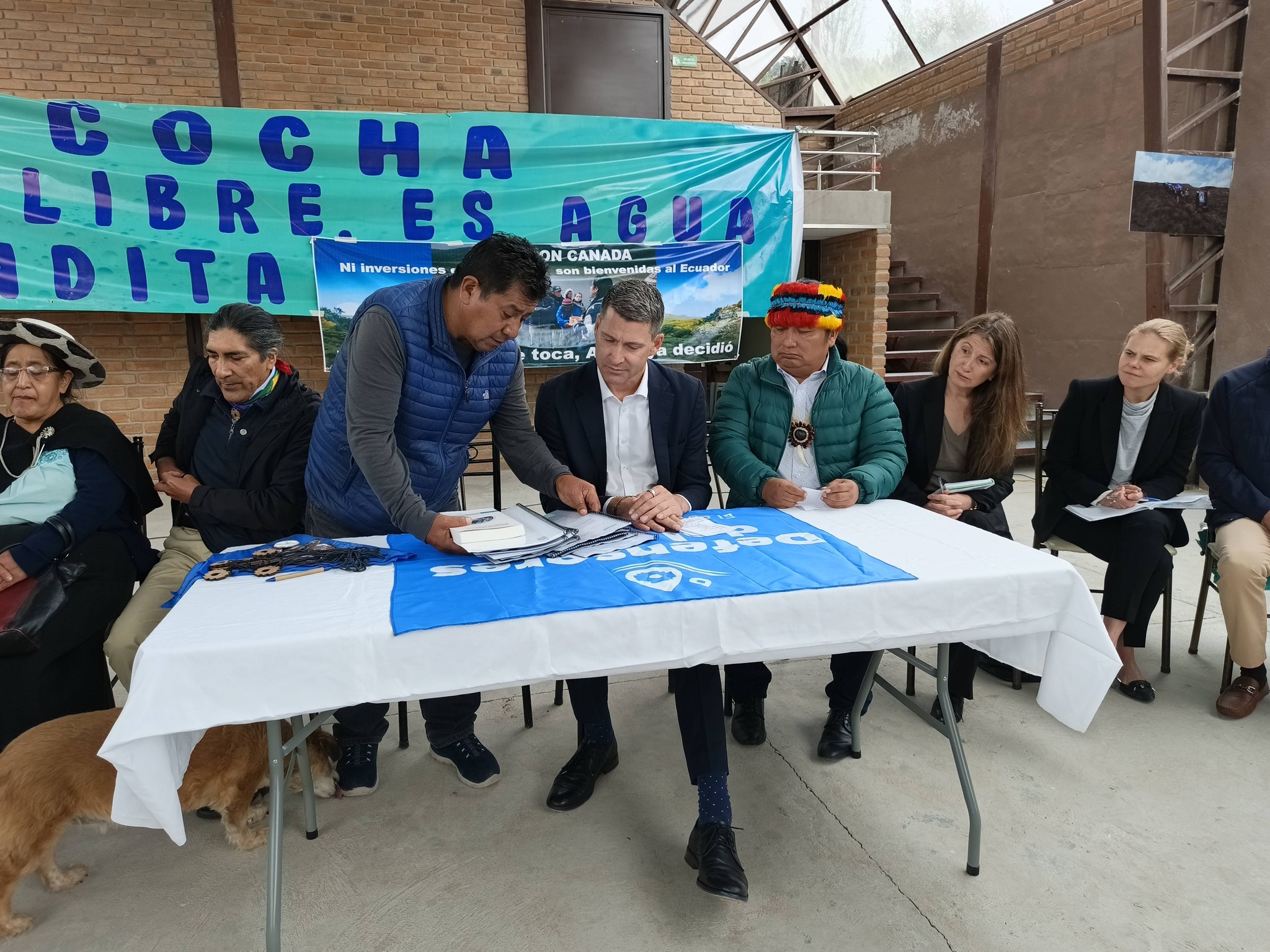
The leaders took the opportunity to remind the embassy about the two binding referendums in the cities of Girón and Cuenca, where residents overwhelmingly voted in favour of banning mining in the water sources; last year’s historic march for the protection of water in Cuenca; and the criminalization they have faced for protecting water, among others. They handed over to the Canadian ambassador and his team multiple documents documenting the social and legal actions they have carried out to protect Kimsakocha in the last 32 years, as well as several independent environmental reports that demonstrate the environmental risks of the Loma Larga project.
The FOA community representatives made two specific demands for the Canadian embassy at the assembly:
- To withdraw political, diplomatic, and business support from Canadian companies that intend to exploit Indigenous territories in Ecuador in areas such as the Las Naves/Bolívar canton, Palo Quemado, Las Pampas/Cotopaxi, and the Amazon, among others. Further, to conduct a thorough and exhaustive investigation into the actions of Canadian mining companies that are violating human rights and the rights of Pachamama (Mother Nature), so that these actions do not go unpunished and do not tarnish the good name of the Canadian people.
- To provide all the information about the Free Trade Agreement between Ecuador and Canada, and to consult with ancestral communities about this agreement prior to its signing and enactment. The agreement must not include any confidentiality clauses or international arbitration clauses, because Ecuador is a sovereign country that recognizes plurinationality, collective rights, particularly the Rights of Mother Nature, as well as the body of human rights norms and jurisprudence derived from the universal inter-American human rights system. Ecuadorians deserve peace, tranquility, Sumak Kawsay, ecological justice, and social justice.
These demands were outlined and summarized in a letter provided by the FOA to the Canadian ambassador during the meeting, available here (in Spanish).
The following are excerpts from the statements expressed by communities’ representatives during the meeting with the Canadian ambassador:
“The company is lying, invading the ancestral lands of our grandparents and great-grandparents. We cannot allow a foreign company to come in and destroy everything… All of us here are farmers and ranchers. That is why we do not want our water contaminated.” Lizardo Zhagüi, Community Water Systems of Tarqui, Victoria del Portete.
“We lived peacefully in harmony until the looters arrived—all mining companies without exception, including Canadian companies IAMGOLD, INV METALS, and DPM Metals. They have all fractured communities, discredited us, and now criminalized six of our comrades for the alleged crime of trespassing and damage to property – in other words, for the sin of denouncing the mining company and cleaning up the mining waste they left behind in the Kimsakocha páramo…
Therefore, Mr. Ambassador, the best way the Canadian government can support and cooperate with the communities of Ecuador is by not signing the Free Trade Agreement, not accepting destructive metal mining, and conducting a thorough investigation into the companies that are violating the rights of nature and human rights. This is the first step in defending the water and the lives of our children.” Yaku Perez, lawyer of the FOA.
“No more looting, no more dispossession of Indigenous peoples from their territories. Canada should support food sovereignty, community tourism, and agriculture instead of pushing for mining and oil expansion. I ask the ambassador to ensure that this message we bring to you as Ecuadorians reaches the ears of the Canadian government and that it be respected. These companies that always come to cause damage and divisions in the territories between brothers and sisters should not be financed. We will continue to be vigilant to ensure that the decisions of the grassroots movements and the peoples who defend the water are respected and that mining companies never return to this territory.” Marlon Vargas, president of the Confederation of Indigenous Nationalities of Ecuador (CONAIE).
“We don't want a country dominated by large scale mining; we want a country that promotes ecotourism, agriculture, organic farming, and nature. We reject poverty. We already know what happens when large scale mining projects like those in Cajamarca, Peru, and El Mirador, Ecuador, are installed in our territories!” Lauro Sigcha, president of the FOA.
“We hope, Mr. Ambassador, that once again you will listen to the voices of the women who have been fighting for more than three decades, who have been beaten, including children and the elderly. We want to live in peace and tranquility. We do not want to be criminalized any longer.
We hope that you will tell us that you will support our demands, and that mining will no longer take place here in Kimsakocha. We want the mining companies to leave. We don't want the mining company to continue deceiving us; we don't want any more lies. We will continue the fight. Long live Kimsakocha, and long live water!” Miriam Chuchuca, Professor in the Kimsakocha area.
“Thank you for coming to witness our struggle, because those who come to extract our wealth will not tell you the truth about what they are doing to us. On the contrary, they join forces with president and the police…I am a woman who depends on my crops, on my Pachamama. If they contaminate our water, how will I live? My grandparents told me that gold is the seed of water, and that is why it must be left underground. I don't want them [mining companies] to come and steal this treasure from us. You wouldn’t let us plunder the gold from your country, would you?” Angelita Loja, long-standing water defender from Victoria del Portete.
“I understand that you act as a bridge with the private company, and we want you to deliver the following message: the people have defended Pachamama and water not only now but for more than 32 years! If we allow the mining company to enter, what will we see instead of the lagoons in the páramo? Houses, companies, vehicles, a hole! NO, that is not compatible with our territory!” Luis Guaman, President of the Parish of Baños.